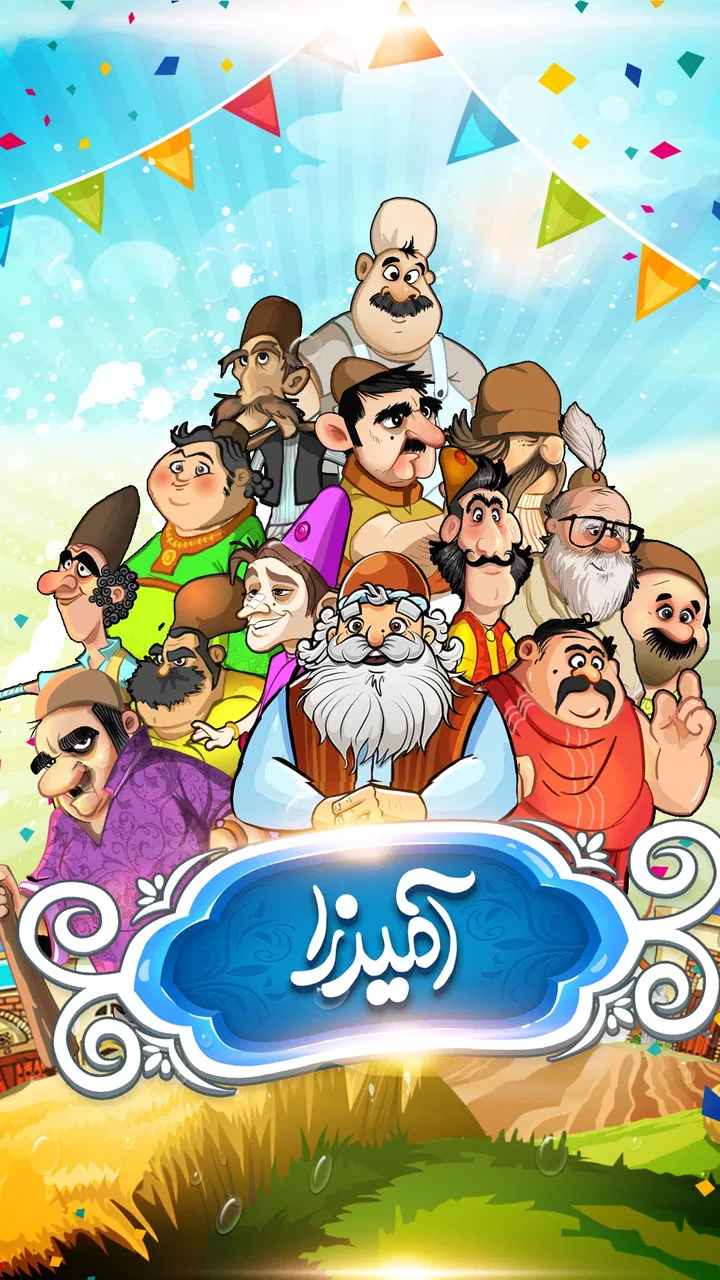
آمیرزا
- 4.8
- Rating
- 10.00M
- Installs
- Free
- Price

 Analysis by App-foxy
I approached آمیرزا as a quick word game rather than something meant to occupy an entire evening. That distinction matters. Its Persian-language focus gives it a clear identity, while the simple premise makes it easy to open when I have a few spare minutes. I found the appeal strongest when I wanted a short mental break, a little vocabulary practice, or a game that did not require learning a complicated control system first.
The game comes from Brain Ladder Game Studio and is available free of charge for Everyone. It belongs firmly in the word-game category, but its Persian presentation is what separates it from the usual English anagram and crossword options. The store identifies it as a popular Persian game built around words, and that description is brief but useful: this is aimed at players who want to work with Persian vocabulary, not simply a translated version of a familiar international puzzle.
How the game feels during short and longer sessions
I find the game most satisfying when I let a brief visit stay brief, but a longer stretch changes the experience: concentration becomes part of the challenge, not just a way to pass time. I’ll look at how that shift affects the pace and what makes it easier to return without turning play into a chore.
You May Also Like

 Blood Strike: 2.5 Anniversary
Blood Strike’s Loadouts Turn Every Drop Into a Tactical Gamble
A close look at Blood Strike’s custom loadouts: how fast access to signature weapons reshapes its battle royale rhythm, rewards preparation, and narrows the gap between fights.

 Pandora - Music & Podcasts
Pandora’s Music Is Easy to Start, but Harder to Recover
Pandora’s strength is its low-effort path from a seed to a station. Its weak spot is how much confidence it asks you to place in connection, setup, and quiet recovery.

 8 Ball Pool
 Is Built on Rivalries, Rematches, and Routine
A close look at the rivalries, rematches, shared routines, and unanswered safety questions that turn a quick pool match into a persistent mobile community.

 Samsung Music
’s Quiet Strength Is Playing What You Already Own
Its reach comes less from spectacle than from dependable access to a personal library. That simplicity is both the app’s strongest retention engine and its ceiling.

 AccuWeather: Weather Radar
AccuWeather Review: A Quick, Clear Forecast for Everyday Decisions
For everyday plans, the best forecast is the one you can understand quickly. AccuWeather makes rain timing, radar, and local conditions easy to act on, with a few trade-offs.

 Hill Climb Racing
Why Hill Climb Racing Still Turns Crashes Into One More Run
A tiny car, a bumpy hill and one more upgrade: Hill Climb Racing keeps resurfacing because its simple chaos makes every near-miss feel personal.
More From Our News Desk
View All News


Quick starts and realistic speed expectations
My first impression was that آمیرزا is suited to fast starts. A word puzzle generally has a lower mental and technical entry cost than an action game, and that is exactly where this title makes sense in daily use. I can imagine opening it while waiting for transport, during a coffee break, or after finishing a small task at home. There is no need to prepare a long session or remember a complex control scheme.
The important kind of speed here is not only how quickly the game opens. It is also how quickly I can understand what I am expected to do. The word-game format makes the objective immediately approachable for a Persian reader. That keeps the first few minutes comfortable, especially for someone who prefers thinking games over reflex challenges.
I would not choose it when I want a fast competitive match or constant visual action. Word puzzles naturally slow the player down at the point where the actual challenge begins: finding the right word. That is a positive for concentration, but it means the game’s rhythm depends on my vocabulary and patience. A player who expects instant rounds and constant rewards may experience the pauses between discoveries as friction rather than relaxation.
One useful way to play is to treat each visit as a small exercise instead of chasing a long uninterrupted run. I found that approach better for maintaining attention. If I become stuck, leaving the puzzle for a while can be more productive than repeatedly tapping around with no plan. Returning later gives the letters a fresh look, which is a practical advantage of this type of game.
What happens when I play for longer
Short sessions are the natural strength, but longer use reveals a different trade-off. The basic word format remains accessible, yet the mental effort can build when several puzzles require similar concentration. I would not describe this as a flaw in the design; it is simply the point at which a relaxing word game starts to feel like deliberate study.
For me, the best longer-session habit would be to alternate between solving and reviewing. Instead of forcing an answer immediately, I can look at the available letters, group possible word patterns, and test familiar Persian words first. This turns the game into a more thoughtful vocabulary workout. It also reduces random guessing, which is less satisfying and teaches me less about how I reached the solution.
That workflow is one of the more useful reasons to keep a word game installed. It can fill a quiet moment without demanding the emotional commitment of a story game or the uninterrupted attention of an online match. On the other hand, players who mainly want broad language learning, pronunciation practice, or structured lessons should not mistake it for a complete language course. Its value is centered on solving words, not replacing formal study.
Heavy-use moments and mental load
The most demanding moments are likely to come when I use it continuously and encounter words that are less familiar to me. In those situations, the challenge is not physical performance or complicated navigation. It is the combination of recall, pattern recognition, and willingness to try another possibility after an incorrect guess.
I appreciate that kind of difficulty because it gives the game a clear purpose. Still, it can expose a limitation for beginners or for players whose Persian vocabulary is limited. A puzzle that feels pleasantly clever to one person may feel opaque to another, especially when the player knows the letters but does not recognize the possible word. That makes the intended audience important: this is a better fit for Persian readers comfortable with wordplay than for someone using the game as a first introduction to the language.
A practical tip is to avoid treating every unfamiliar answer as a failure. I would use difficult rounds as a prompt to notice recurring word shapes and less obvious vocabulary. The benefit is gradual familiarity, but it requires a patient attitude. If I only care about clearing stages as quickly as possible, the same moments may become irritating.
Another trade-off appears when playing while tired. Word games can seem lightweight because they do not require fast reactions, yet mental fatigue still affects performance. I may stare at a simple arrangement and miss an answer that would be obvious later. For that reason, I prefer using it during a break when I want focused distraction, not when I am already too exhausted to think.
Stability, recovery, and everyday reliability
From a reliability perspective, I look for whether a game fits naturally into repeated small visits. A word title has an advantage over a graphically demanding game because its central activity is conceptually simple. That makes it easier to recommend for ordinary downtime, although a simple format does not automatically guarantee perfect behavior on every phone or network.
I would still follow sensible habits: keep the app updated, avoid opening it when the device is critically low on storage, and return to the same puzzle calmly if an interruption occurs. These are not special requirements for this title; they are practical ways to protect progress in any mobile game. If a call, notification, or system interruption breaks a session, the best recovery approach is to reopen the game and check the current puzzle before making more attempts.
The age rating of Everyone also makes the game approachable for a broad household audience. I can see it working for a family member who wants a quieter activity, provided that person reads Persian comfortably. That rating should not be interpreted as a guarantee that every player will find the vocabulary easy. Accessibility of tone and suitability of content are different from accessibility of language.
The game has been available since Apr 25, 2019, which gives it a longer presence than a newly released experiment. Its current version is 11.8, so someone installing it today is receiving a maintained version rather than an untouched launch build. I would not use the version number alone as proof of flawless stability, but it does make the title feel established enough to consider for regular use.
Device limits and resource expectations
آمیرزا supports devices running Android 5.1 or later. That is helpful for people using older Android hardware, although compatibility by operating-system version is only one part of the experience. An older phone may still have slower storage, limited memory, or a crowded background workload. In those conditions, the sensible expectation is a more modest experience than on a recent device.
The game’s word-focused nature makes it a more realistic candidate for older or less powerful phones than visually intensive action titles. I would choose it for a spare device precisely because the category does not depend on elaborate graphics or rapid camera movement. Even so, I would not promise identical responsiveness across every handset. Device condition, available space, and other running apps can affect how any mobile title behaves.
For a phone that struggles with many installed games, this is the kind of app I would test before removing more demanding entertainment. It has a clear use case without asking the device to serve as a gaming console. If the phone is extremely old or unstable in general, however, the operating-system requirement still matters, and installing the game may not solve broader performance problems.
Battery expectations should also be kept realistic. A word game is a sensible choice when I want a less intense alternative to a title with constant animation, but I would avoid inventing a precise battery claim. The actual drain depends on the phone, screen brightness, connection conditions, and how long I play. The fair conclusion is that its format is naturally more restrained than a demanding action game, not that every device will show the same result.
How it compares with familiar alternatives
Compared with a crossword app, this game is likely to appeal more to someone who enjoys building words from available possibilities than filling a large clue-based grid. A crossword places more emphasis on definitions and intersecting answers. Here, the attraction is the direct relationship between the letters and the word I am trying to uncover. If I enjoy deduction from clues, a traditional crossword may be a better match; if I like rearranging and testing vocabulary, this title is more relevant.
It also differs from English word games in a fundamental way: the language is not a decorative setting. Persian vocabulary determines whether the puzzle feels natural or inaccessible. That makes the game especially worthwhile for Persian-speaking users who find international word apps linguistically irrelevant. Conversely, an English-speaking player without Persian reading ability should skip it rather than expect it to function as a universal word trainer.
Compared with a full language-learning app, آمیرزا is narrower but potentially more enjoyable for casual practice. It does not need to behave like a lesson plan to be useful. I can use it to exercise recognition and recall, then switch to a dedicated educational app when I need grammar, pronunciation, or systematic progression. Choosing between the two depends on whether I want a game first or a curriculum first.
Its free price also changes the decision. I can try it without budgeting for a purchase, which lowers the risk for curious Persian readers. Free does not mean every person will enjoy the same difficulty curve or vocabulary demands, so I would judge it after a few sessions rather than assuming the absence of a price makes it universally suitable.
Who should install it, and who should pass
I would recommend this game to Persian readers who enjoy word puzzles, people looking for a quiet phone activity, and families wanting an Everyone-rated title with a language-specific identity. It is also a sensible option for anyone who prefers short sessions that can be paused mentally, even if the phone itself is not being used for a long continuous gaming period.
I would be more cautious about recommending it to someone who needs explicit language instruction. The game may support vocabulary familiarity through repeated solving, but that is different from explaining why a word is correct or teaching how to use it in conversation. I would also point action-game fans toward another category if their priority is speed, competition, or visual spectacle.
Players who dislike getting stuck should consider whether they enjoy the process as much as the result. The strongest word games ask me to tolerate uncertainty. If I want every round to be immediately clear, the central challenge may feel like an obstacle. If I enjoy the small satisfaction of recognizing a solution after several attempts, the same design becomes the reason to return.
My performance verdict after using it as a daily game
My overall view is that آمیرزا works best as a focused, low-commitment Persian word game. Its established release history, current version 11.8, and broad Android compatibility make it a practical candidate for many users, while the format keeps the experience approachable on devices that are not built for demanding games. I would describe its perceived performance as appropriately light for its category, while still leaving room for normal differences between phones.
The game has reached more than 10 million installs and holds a 4.7 average from around 71 thousand ratings, with roughly 713 reviews shown alongside it. Those figures suggest a substantial audience and strong reception, but I treat them as context rather than a substitute for personal fit. The key question is whether I enjoy Persian wordplay. If the answer is yes, the popularity makes sense; if not, a high average cannot overcome the language barrier.
My practical recommendation is to install it for short Persian vocabulary sessions, not as a replacement for a full language course or a fast action game. I would keep the rounds brief when I am tired, use deliberate letter-pattern thinking when stuck, and choose another app when I need pronunciation, grammar, or competitive multiplayer. Within its specific purpose, Brain Ladder Game Studio has produced a game that feels easy to approach, mentally engaging, and particularly valuable to the audience that wants wordplay in Persian rather than another generic translation.
After using it this way, I see the title as a dependable casual choice rather than an all-purpose game. It earns a place on my phone because it gives quiet moments a clear activity without demanding high-end hardware or a large time commitment. The people most likely to enjoy it are those who want the pleasure of finding words and are comfortable letting a puzzle challenge them before it gives up its answer.
FAQs for آمیرزا
01What is the main objective of آمیرزا?
آمیرزا is a word puzzle game designed to challenge your vocabulary and problem-solving skills. The primary goal is to form words by connecting letters in a grid. Players are tasked with finding all possible word combinations, progressing through increasingly difficult levels with unique themes and challenges.
02Is آمیرزا available for both Android and iOS devices?
Yes, آمیرزا is available on both Android and iOS platforms. You can download it from the Google Play Store for Android devices or from the Apple App Store for iOS devices. The game is optimized for a smooth and engaging experience on both operating systems.
03Does آمیرزا require an internet connection to play?
آمیرزا can be played offline, making it a great option for users who want to enjoy the game without an active internet connection. However, some features, such as updates or leaderboards, may require connectivity. Playing offline ensures that you can enjoy the game anytime and anywhere.
04Are there any in-app purchases in آمیرزا?
آمیرزا offers in-app purchases that allow players to buy hints or remove ads for a more streamlined gaming experience. While the game is free to download and play, these optional purchases can enhance gameplay and help players progress through challenging levels more easily.
05How does آمیرزا enhance language skills?
آمیرزا is designed to improve language skills by challenging players to discover new words and expand their vocabulary. As you progress, the game presents increasingly complex puzzles, encouraging you to think creatively and strategically. It's an engaging way to practice language while having fun.
Pros
- Engaging puzzles enhance cognitive skills.
- Visually appealing and user-friendly interface.
- Regular updates with new puzzles.
- Supports offline play for convenience.
- Encourages learning Persian vocabulary.
Cons
- Limited language options available.
- In-app purchases can be costly.
- Some puzzles are excessively difficult.
- Requires frequent hints for progress.
- Ads may interrupt gameplay experience.

آمیرزا
Gallery